Chinese culture is old – very old. Confucius developed the principles according to which Chinese society works and functioned as early as 500 BC. This philosophy has not only survived for centuries, it has also found its way into corporate philosophy. As it differs greatly from the management philosophy practiced in Germany, intercultural training in China is an important success factor in the run-up to an assignment or close cooperation with Chinese partners.
The five relationships according to Confucius
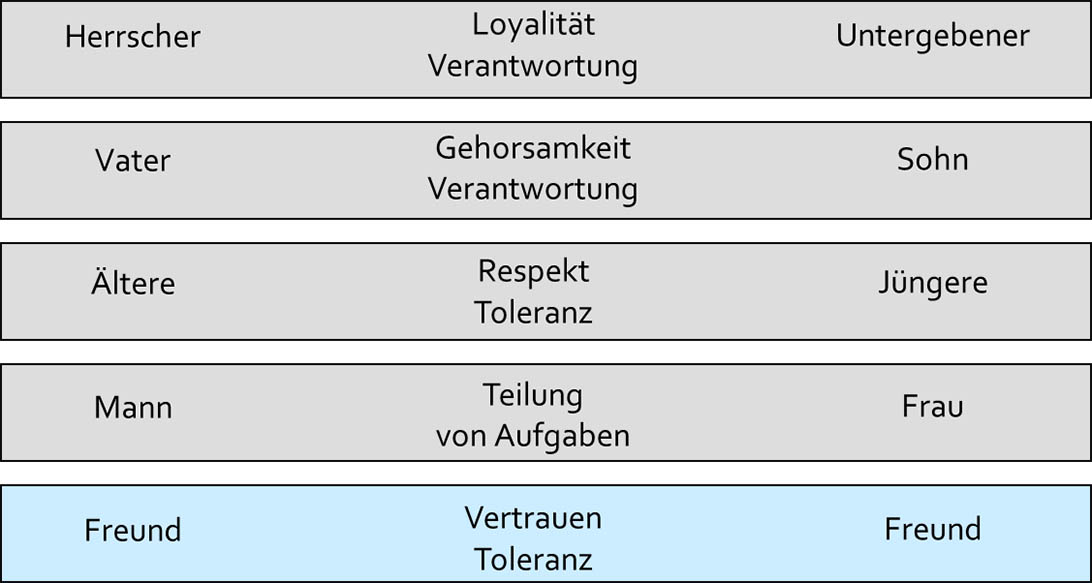
It is important to note that, with the exception of friendly relationships, all relationships have a hierarchy. The “superior” is on the left in this overview. For companies, this means that there is a clear hierarchical relationship between boss and subordinate. However, both must fulfill certain roles that are very different from the German understanding of management.
Understanding of leadership in Germany
There has been a significant change in values in Germany in recent decades. Hierarchical management principles are considered outdated. This means an exchange between superiors and employees at eye level. At the same time, employees are given more responsibility and more scope for decision-making. This requires trust in employees’ skills, self-direction and integrity. Working hours are also handled more flexibly, and the possibilities of virtual collaboration also make it possible to work from home.
The role of the line manager has therefore changed to become more of a coach who supports employees, uses their expertise, allows critical discussions and builds consensus.
The representatives of Generation X and Y in particular, who are increasingly dominating the job market, expect the most direct cooperation possible with management. In times of an emerging shortage of skilled workers, companies are increasingly adapting to this.
Understanding leadership in China
A good term for leadership in China is “caring leadership”. This stems from the traditional understanding of roles.
Distribution of roles in China
The Chinese prefer a clear and hierarchical distribution of roles, which results in rights and obligations for both sides. Decisions are made by the line manager or at least agreed with them. This means that Chinese employees have relatively little scope for decision-making. At the same time, the line manager is expected to be a role model and a professional expert who is the final authority and can also guide employees. In return, they earn the respect of their employees.
The social system in the office in China
Based on the roles, it becomes clear that there is no exchange of points of view on an equal footing. However, this does not mean that a good supervisor is the “ruler of all the bosses”. Good supervisors in China seek exchange and contact with their employees. However, this process is initiated and controlled “from above”. Automatic feedback “from below”, as expected in Germany, does not correspond to the Chinese understanding of management
The role of the supervisor in China
It is clear from these statements that the line manager takes on the role of a “father figure”. Employees expect him or her to take a caring role that extends not only to the office, but also to their private lives. The latter is expressed, for example, in the fact that superiors are invited to wedding celebrations or are also consulted on personal matters. This aspect in particular is often underestimated by German managers in China, as there is a strict separation between professional and private life in Germany and the boss “has no business” in private life.
Other priorities in China
In China, priorities are also set differently in business life. In Germany, the focus is on responsibilities and specialist knowledge. In China, on the other hand, social understanding and group harmony dominate. This means that work processes are not organized according to factual requirements alone. Here, the boss is also very important as a role model for the employees and the personal and moral development of the employees, as well as the aforementioned professional guidance, play a major role.
Intercultural preparation
Here it becomes clear that good intercultural preparation, e.g. through intercultural training in China, plays a major role when German managers are sent to China. But even if it is “only” a matter of working with Chinese partners or colleagues, this basic understanding is essential in order to know the contexts in China and to interpret them correctly, e.g. with regard to working methods and decisions.