Italy – a place of longing for the Teutons
Italy has exerted a magical attraction on Germans for centuries. In the post-war period, people drove over the Alps in an overloaded VW Beetle, which was still something of an adventure back then. But the main thing was sun, wine and Bella Italia. Rudi Schuricke sang about the Capri fishermen and Caterina Valente made Germans’ mouths water with “Komm ein bisschen mit nach Italien…”. Of course, this also gave rise to inevitable prejudices. The Germans in particular think so highly of their engineering skills that they easily overlook the fact that there are also important inventions and inventors in other nations that are perhaps not doing so well economically. In Italy, for example, Marconi, the pioneer of wireless radio transmission.
The fact that masses of Italian guest workers flocked to Germany in the 1950s easily created the image of poor and backward Italy. It is true that purchasing power was generally higher in Germany, but northern Italy was already an industrial heavyweight in Europe at the time. As far as automobiles were concerned, Fiat from Turin motorized the masses. Ferrari, Maserati & Co. built dream cars and design studios such as Pininfarina, Ghia, Zagato or Bertone not only dressed Italian cars, but cars all over Europe!
A manufacturer that had achieved fame in racing in the 1920s and 1930s and produced exclusive vehicles for the “Happy Few” succeeded in establishing itself successfully in the mass market after the Second World War by using racing technology and new production methods – Alfa Romeo. Few models have made such a lasting contribution to the reputation of a brand as the Alfa Romeo Giulia. Here is proof of the Italian art of engineering, which the author recently published in a classic car club magazine.
Alfa Romeo invents the sports sedan for everyone
No, it is not a paragon of elegance that is presented in Monza in 1962. Comments about the car designed by Alfa Romeo’s Centro Stile ranged from unrepresentative to ugly, original but playful. But it is fast. A Grand Turismo with 4 doors, as Hobby magazine wrote in its 24/62 issue. We are, of course, talking about the Alfa Romeo Giulia TI (“Turismo Internazionale”), which saw the light of day in 1962 and was not yet really understood by the world. The love for this car, so popular today, first had to grow. With its 1.6 liter engine, 92 hp and a top speed of 170 km/h, it outclassed the competition. I took the pictures of this genuine “original Giulia” with the kind permission of Autohaus Eyring in Hofheim am Taunus, where it was available for purchase. Also a good address for servicing classic Alfas.
What else was driving in Germany back then?
Back then, it felt like half of Germany drove VW Beetles. My father had one too. On good days, the speedometer needle shuddered to 115, but the other popular German and European competitors couldn’t hold a candle to the Giulia either. Want some examples?
- Ford Taunus 17M TS – 1.7 l – 75 hp – 152 km/h
- Opel Rekord A – 1.7 S – 67 hp – 142 km/h
- Fiat 1500 – 1.5 l – 67 hp – 150 km/h
- Fiat 1800 – 1.8 l – 81 hp – 146 km/h
- Volvo 122 S – 1.8 l -83 hp – 150 km/h
Even the most powerful Porsche of the time only had 90 hp, which would not change until the following year when the 911 appeared with 130 hp! Interestingly, BMW launched the “New Class” in the same year, the first representative of which was the BMW 1500 with 80 hp and a top speed of 150 km/h. And even the 1800, which followed a year later, “only” managed 160 km/h despite its larger displacement and 90 hp. Interestingly, there was also a more powerful version of the 1800 with 110 hp and a top speed of 170 km/h. BMW called it the 1800 TI. A rogue who thinks evil of it. This was the environment in which the Giulia was “born”. To get similar performance, you had to look 1 to 2 classes higher!
Zeitgeist versus sportiness – it all starts with a compromise
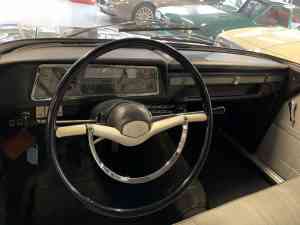
At first, Alfa Romeo did not quite trust the sportiness of the car, so they initially relied on the mainstream fashion of the time for some details. Although there were five gears, they were sorted by a steering wheel gearshift. Instead, there was a full-length bench seat at the front, which could not be used by three people due to the cardan tunnel. A tachometer visually contrasted with the promise of the rev counter and, surprisingly, drum brakes instead of disc brakes slowed the Giulia down all round. No, Alfa Romeo didn’t seem to trust the brakes quite yet, although the concept was well thought out. It was not until 1963 that the drum brakes were replaced by disc brakes, followed in 1964 by the stick shift with separate front seats and in 1965, together with the launch of the Giulia Super, round instruments and a sporty three-spoke steering wheel.
Innovations à la italiana – concept and technology
So what made the Giulia so extraordinary, apart from the fact that it was a fast sedan? Several things, with the aviation background of the responsible designer playing a role. Planning began in 1959 on “a blank sheet of paper”. Alfa Romeo and its chief engineer Orazio Satta Puglia wanted to create something truly new and revolutionary:
- “The wind shaped the Giulia”. The design department had the task of making it as streamlined as possible, which they succeeded in doing. This is how the Giulia got its rear trailing edge. The tests were sometimes very rustic. The car was accelerated to a certain speed and then allowed to coast. The further it went, the better the cw value was. It was actually a simple thing that worked and was confirmed in the wind tunnel in Turin. Although the shape of the Giulia is reminiscent of a shoe box, it was not until the 1980s that its Cd value of 0.34 was undercut in this class!
- Safety was emphasized, crumple zones were developed and innovative crash tests were carried out, the results of which were incorporated into the design. This made Alfa Romeo one of the pioneers in this field, together with Mercedes-Benz and General Motors. There was also a split steering column, no protruding edges in the interior and a cupped steering wheel. From today’s perspective, the Giulia does not look particularly safe, as it lacks the “reassuring mass”. But it was actually considered one of the safest cars of the time.
- Racing technology and five-speed gearshift. At a time when four instead of three gears were just becoming standard, this was not new at Alfa, but it was still innovative. Two overhead camshafts controlled the valves – something that was still only available in real sports cars.
- Last but not least, the concept of a compact sports sedan was new. There was nothing like it in this vehicle class. Interestingly, BMW was also embarking on this path at the same time. The Giulia and the BMW 02 then became direct competitors, appealing to the same audience.
It was a bold move, because the Giulia was to replace two models from the 1950s: The smaller Giulietta and the larger Alfa Romeo 1900, and it succeeded. The Giulia was the basis for an entire product family: the coupés with the name Sprint and the Spider, which replaced the old convertibles from the 1950s in 1966 under the name “Duetto” and achieved unimagined popularity thanks to the film “The Graduate” with Dustin Hoffmann.
From 1600 to 1300
For tax reasons, however, anyone who wanted to achieve unit sales in Italy needed a vehicle in the 1.3-liter class. Consequently, Alfa Romeo introduced the 1300 Giulia in 1964, which initially had to make do with 78 hp, but was upgraded to 89 hp as part of various model updates (some sources also state 87 or 88 hp). Interestingly, different power versions could be ordered in parallel. The 1300 received a slimmed-down specification and was externally recognizable by its simple headlights. The twin headlights were reserved for the 1600. At least until 1971, when the only difference between the two versions was the equipment and the lettering at the rear.
More power
The Giulia TI Super appeared as early as 1963 – in 501 units. The number indicates that it was a racing vehicle. This is because exactly 500+1 units were required for sporting homologation, which were used for regular road use. The 1.6-liter engine was taken from the Spider Veloce, the engine output was 112 hp thanks to two twin carburetors and the rest was consistently simplified. It even lacked heating and high beam headlights. This enabled the car to reach almost 190 km/h. 499 of these vehicles were delivered in white and marked with a green cloverleaf (Quadrifoglio verde), which was to become the symbol for particularly powerful Alfa Romeo models from then on. There were no conversions of regular Giulias – it was virtually impossible to turn a regular TI into a TI Super.
A different approach was chosen for the “bourgeois” Giulias. Instead of further upgrading the 1600cc engine, the more powerful engine from the Giulia Sprint GTC was stripped out and the car’s equipment upgraded. At the same time, the chrome surrounds on the headlights and radiator grille disappeared. All models were now given a black radiator grille with three chrome strips. The whole thing was called the Giulia Super and now offered 98 hp and a top speed of 175 km/h with the same displacement – the breakthrough on the international markets, including Germany. From then on, this model shaped the image of the Giulia and, to a large extent, of Alfa Romeo. By 1971, the power output had increased to 103 hp. And it was to stay that way.
The 1600 S model with 95 hp, which had been designed as an economical touring car, made a brief guest appearance from 1968. Not a bad idea, but as its performance was too close to that of the 1300 Giulia, customers preferred the smaller model for tax reasons, so sales were discontinued as early as 1969.
In 1968/1969, 16 Giulia Super station wagons, known as Promiscua, were produced as special editions.
Alfa Romeo answered the call for even more performance and luxury by not upgrading the Giulia further, but by launching a new model on the market. Based on the Giulia, the enlarged but rather soberly styled Alfa Romeo Berlina 1750 (the name is a reminiscence of the legendary 1.75-liter racing engines from the 1930s) with 1779 cc, 118 hp and a top speed of 181 km/h appeared in 1968. In 1970, this became the Alfa Romeo Berlina 2000 with 1962 cc, 131 hp and a top speed of 193 km/h (at the time, this was the fastest car in one of my car quartets, something that sticks in the mind!) The so-called 105 engine had thus reached its final technical stage of development. Quite a few fans regret that the 2-liter engine was never available in the Giulia, which is why some retrofitted this engine in their Giulia to turn it into a real projectile. It can be done, but in my opinion it doesn’t have to be.
More than just a swan song
At the beginning of the 1970s, the Giulia had actually reached the end of its life cycle. Alfa Romeo, however, was not bedded on roses, which is why the introduction of successor models was delayed. So what was available had to be spiced up once again.
Alfa Romeo changed the Giulia thoroughly once again. To the horror of many Alfa fans, the typical beading in the trunk was ironed out, the twin headlights were given the same size as on the 2000 Berlina and now sat in a black plastic radiator grille. Inside, the instrument dials were given a blue background, wood veneer made the interior more homely and a deeply cupped wooden steering wheel gave it a more sporty character. Milanese baroque at its finest.
Under the bodywork, everything remained the same. In other words – the engines and driving performance were still competitive! And to make sure everyone was aware of this, it was now called the Giulia Nuova Super. The successor, the new Giulietta, appeared in 1977, but the Nuova Super could still be ordered until 1978. The car already had its fan base back then.
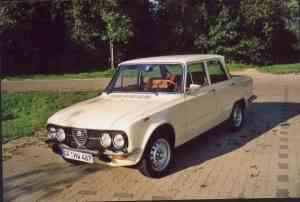
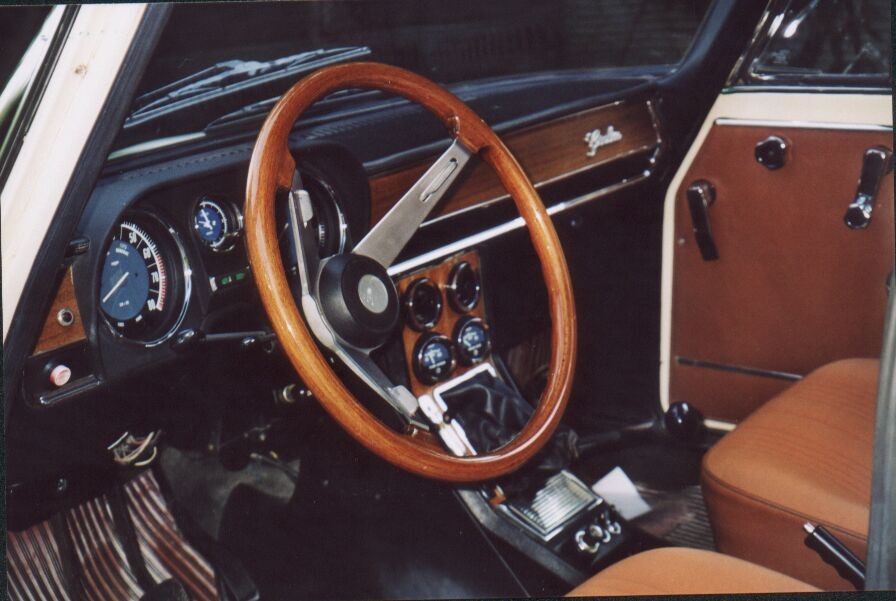
Today, the scene is divided. Some fans have never forgiven Alfa for smoothing out the bodywork and concentrate on the “real Giulias” before 1974. For me, it’s the other way round. As an enthusiastic reader of Auto, Motor und Sport even as a schoolboy (as long as I had enough pocket money), I remember what I thought when I saw the first pictures of the Nuova Super: “Wow, the Giulia finally looks good.” Last but not least, the Nuova Super is the most mature version of the Giulia.
A special feature and an absolute novelty at Alfa Romeo was the Nuova Super Diesel (the oil crisis sends its regards), which was offered from 1976, but only in Italy. Equipped with an English Perkins diesel engine, it had a leisurely 55 hp. Apart from the Giulietta of the 1950s, it remained the only post-war Alfa Romeo model whose speedometer scale ended at 160. A nice rounding up, because no more than 138 km/h was possible.
Sales figures
The Giulia sold very well, partly due to its membership of the EEC at the time. A total of 526,000 units were sold. If you add the “large models” 1750 and 2000 Berlina (orange), both series even reached 715,000 units.
Model overview
For better orientation, here is a brief overview of the individual models and their construction period.
| Model | Technical data | 62 | 63 | 64 | 65 | 66 | 67 | 68 | 69 | 70 | 71 | 72 | 73 | 74 | 75 | 76 | 77 | 78 |
| Giulia TI | 1570 cc, 92 hp, 170 km/h |
x | x | x | x | x | x | |||||||||||
| Giulia TI Super | 1570 cc, 112 hp, 189 km/h | x |
x | |||||||||||||||
| 1300 | 1290 cc, 78 hp, 155 km/h |
x | x | x | x | x | x | x | x | |||||||||
| Giulia Super | 1570 cc, 98 hp, 175 km/h | x | x | x | x | x | x | x | ||||||||||
| Giulia 1300 TI | 1290 cc, 82 hp, 160 km/h | x | x | x | x | x | x | x |
x | |||||||||
| Giulia 1600 S | 1570 cc, 95 hp, 170 km/h |
x |
x | |||||||||||||||
| Giulia 1300 Super | 1290 cc, 87 hp, 166 km/h | x | x | x | x |
x | ||||||||||||
| Giulia 1600 Super | 1570 cc, 103 hp, 175 km/h | x | x | x |
x | |||||||||||||
| Giulia Nuova Super 1300 | 1290 cc, 87 hp, 165 km/h |
x | x | x | x |
x | ||||||||||||
| Giulia Nuova Super 1600 | 1570 cc, 102 hp, 175 km/h | x | x | x | x |
x | ||||||||||||
| Giulia Diesel | 1760 cc, 55 hp, 138 km/h | x | x |
x |
Source: “Alfa Romeo – All production cars since 1950” by Karl Lange and “Alfa Romeo Giulia” by Lorenzo Ardizio
Legends never die
The Giulia achieved cult and legendary status. This was also reflected in the Giulia’s current price level, although the number of vehicles on offer is quite large. Original vehicles from the 60s are not offered for less than 15,000 and often more than 20,000 euros. Or you can do as I did and go for the “cheap” Nuova Super.
The Giulia was a car that many people wanted and could afford at a certain salary level. It was only common sense that made the “dreamers” turn to the usual suspects (BMW, Ford, Opel, etc.). But perhaps that is precisely why the “real dream cars” are so popular today. Then as now, an old Ferrari is only affordable for the “happy few”, but an Alfa is within reach. Fritz B. Busch once described this beautifully when he toured northern Italy in a Giulia in the 1980s (“A spring day with Giulia”). He poetically compared the Giulia “to a May morning on Lake Maggiore, when you can feel that there is still everything in the day ahead of you”. No question, he liked the Giulia. And he didn’t forget to mention the passer-by who even asked: “Is that the new Alfa? When is it coming out?”
My experience with the Giulia today
- I’ve been riding a 1975 Giulia Nuova Super 1300 again for a year now and was already the proud owner of a Nuova Super 1300 from 2003 to 2008.
- The Giulia is a compact car, almost a small car by today’s standards.
- The Giulia is economical and, unlike today, it easily undercuts the official fuel consumption figures. On average, I get a consumption of between 7.5-8.5 liters/100 km when traveling. To exceed 10 liters/100 km, you have to constantly drive short distances in the city.
- The Giulia is fast, by the standards of the time anyway. The 87 hp confirmed in the vehicle registration certificate doesn’t sound like much, but even today you can easily keep up with the traffic and accelerate up to 170 km/h if necessary (it just takes a while).
- Freeway driving at 120-140 km/h is no problem, even if it does get noticeably noisy in the interior above 110 km/h.
- The synchronization of the gearbox is an Achilles’ heel in all Alfa gearboxes of the time, usually the 2nd gear is affected. This was also the case with my Giulia. You then have to accelerate between gears or insert a “thought second” before shifting.
- An important detail: the front opening triangular windows. They are an excellent and draught-free substitute for air conditioning, at least as long as you are driving. It’s a shame that they no longer exist today.
- Pay attention to the carburetor flange – it tends to break.
- If you take care to warm up the 6 liters of engine oil gently (20-30 km) and only then really step on the gas, the engine is both durable and reliable.
- The Giulia attracts positive attention. If you enjoy socializing with other people, the Giulia is a great vehicle. This may of course apply to almost all classic cars, but also to the Giulia (see the aforementioned article by Fritz B. Busch).
- The supply of spare parts is not a major problem. Technical parts are usually available to order and maintenance is simple and inexpensive. Only some sheet metal parts are harder to find. For my first Giulia Nuova Super, I was even able to order a complete new set of seat covers from Italy, originally made on the old machines! I don’t know if the company still exists, but that says a lot about the spare parts situation at Alfa.
- Watch out family men – there is enough space for 4 people, even with luggage, as long as you leave the suitcases at home. So the slogan “the family car that wins races” is not made up out of thin air.
- Contrary to the stories often circulated about unreliable Italian vehicles, I can say that my Giulias are/were very reliable. Of course, something always breaks, as with all vehicles of this age. In my experience, if the Giulia won’t start, the battery has to be replaced.
- There are only ever problems with rust, but today the Giulia is used as a fair-weather vehicle.
The heirs
At Alfa Romeo, the Giulia once again inherited a Giulietta. The engines were thoroughly revised and the displacement and power were increased. Later, the 1.8 and 2.0 liter engines also became available in the Giulietta. At the same time, the transaxle drive, which had made its debut in the Alfa Romeo Alfetta in 1972, was used. This may sound good, but a rather boring design, a (still) unusually high rear end and glaring quality defects (including the issue of rust!) ensured that the new Giulietta fell far short of expectations despite the “Alfa Romeo myth”. In eight years of production, just 380,000 units were sold.
The 1750/2000 Berlina models had no direct successor. One could include the Alfetta (1.75 l engine with 122 hp), which was offered parallel to the Berlina 2000 from 1972 and also received the 2.0-liter engine in late model years. From 1979, the ill-fated Alfa 6 was launched, which, as the name suggests, was offered with 6-cylinder engines and therefore actually played a class higher.
This break in the model policy and the quality problems then led to Alfa Romeo having to come under the umbrella of Fiat in 1986. Another small side note: in the 1970s, both BMW, the German representative of family-friendly sports saloons, and Alfa Romeo were almost on a par in terms of sales figures. We all know what BMW made of it.
Literature
If you have enough gasoline in your blood and want to learn a little more, I recommend the following books/booklets, which are also on my shelf and which I consulted for this article. Some are only available as antiquarian books (Ebay helps), if at all, but thankfully there are always new books about Alfa Romeo coming out. The variety of Alfa Romeo literature is generally impressive!
- Alfa Romeo Giulia by Lorenzo Ardizio, Heel Verlag, ISBN 978-9-86852-695-0 (Colorful, clear, informative), 2012
- Alfa Romeo – all production cars since 1950 by Han-Karl Lange, series V.I.P. Motor of Verlagsunion Erich Pabel- Arthur Moewig KG, ISBN 3-8118-3013-9, 1992
- Schrader-Motor-Chronik, Alfa Romeo Giulia+Giulietta, Berlina, Sprint, Spider, Schrader Verlag, ISBN 3-922617-50-6, 1988
- Cars that made history, Giulietta & Giulia 750,101,105 by Dirk-Michael Conradt, Motorbuch Verlag Stuttgart, 1990 (mostly black and white, but very informative)
- The very elaborately designed Alfa Romeo yearbooks are also recommended
- Hobby magazine, issue 24/62 from 7.11.1962
- Various articles in Motor Klassik (e.g. from October 2015)
Intercultural training Italy – Conclusion
What does this story have to do with intercultural training? More than you might think, because it reflects much of what we associate with Italy: Innovative solutions, passion, but also problems with quality. It also shows how Germans and Italians approach things, what is important to them and how they implement it. Intercultural training in Italy addresses precisely these aspects so that cooperation works and the best of both attitudes can be combined.