Employee management: tips and tools – Leadership – a broad field, often untapped
Who will be promoted?
When it comes to selecting new people for management positions in companies, the focus is usually on specialist knowledge. There is no question that a good engineer or a good salesperson, for example, should be rewarded for their achievements. Large companies often put their candidates through assessment centers to determine their suitability. However, the successful candidates then find themselves in a new role for which they are not adequately prepared. Many large companies have therefore established qualification programs to prepare candidates for their new role. However, many companies, especially smaller ones, have not. As good as managers may be professionally, they are confronted with new challenges that require extensive soft skills, namely managing people. Robert Strange McNamara, former President of the Ford Motor Company, Secretary of Defense and President of the World Bank, once summarized this task very aptly as follows: “Management is the most creative of all arts – the art of using talent properly.”
The best footballer is not the best coach
This situation is comparable to footballers. Jürgen Klopp, one of the best-paid and most successful soccer coaches of recent years, was never a national player. He never even played in the 1st Bundesliga. As a coach, however, he formed the Mainz 05 team into such a powerful squad that they were promoted to the Bundesliga. He won several championships and cups with Borussia Dortmund and is now the hopeful at Liverpool FC. These successes had little to do with “learning by doing”. His degree in sports provided a solid foundation for this job. In combination with his experience and personality, he was able to successfully implement his ideas and develop talented players into genuine international top performers. Diego Maradona, on the other hand, considered by many to be the best player in the world in his day, was unable to match his success on the pitch as a coach. This example can also be applied to management in companies.
Training is everything
Having talent is good. But without training and encouragement, the best talents will languish. To use soccer as an example once again: Marco Reus, one of the top performers at club level and in the national team, was once written off as a youngster at Borussia Dortmund. Reus did not give up, changed clubs and developed from a talent to a regular and national player under Lucien Favre at Borussia Mönchengladbach. Without his will to succeed, his perseverance, but also without the appropriate support, nobody outside his circle of friends would know his name today. Both now belong to Borussia Dortmund, in Reus’ case an expensive undertaking for the club, as they had to bring Reus back for a large sum.
Which skills count?
It is clear from our examples that technical competence is an important factor. This includes specific specialist knowledge (knowing how to play soccer), the implementation of this knowledge (setting up the team) and achieving a certain result (playing when ideal: winning). All this is fine, but it is not enough. To really lead a team or department in a targeted and successful way, you also need social skills to analyze and shape situations (who am I dealing with? Crisis?), personal skills (personal skills such as openness, creativity, commitment, tolerance, etc.) and methodological skills (e.g. for project management, time management, working methods, team development). Only the interplay of these areas of competence makes a soccer coach a successful soccer coach or a department head a successful department head.
What makes a good manager?
The wish list of qualities of a good boss usually includes (according to surveys, a selection): He expands his knowledge, delegates tasks, communicates transparently, behaves transparently, is reliable, takes responsibility, gives feedback and criticism, makes important decisions, shows gratitude (a virtue often lost in Germany) , values the working atmosphere, is empathetic and predictable. Sure, everyone would like to have Superman as their boss. But as I said – training is everything! Let’s take a look at the details.
Which management style is the right one?
Experts distinguish between five basic leadership styles:
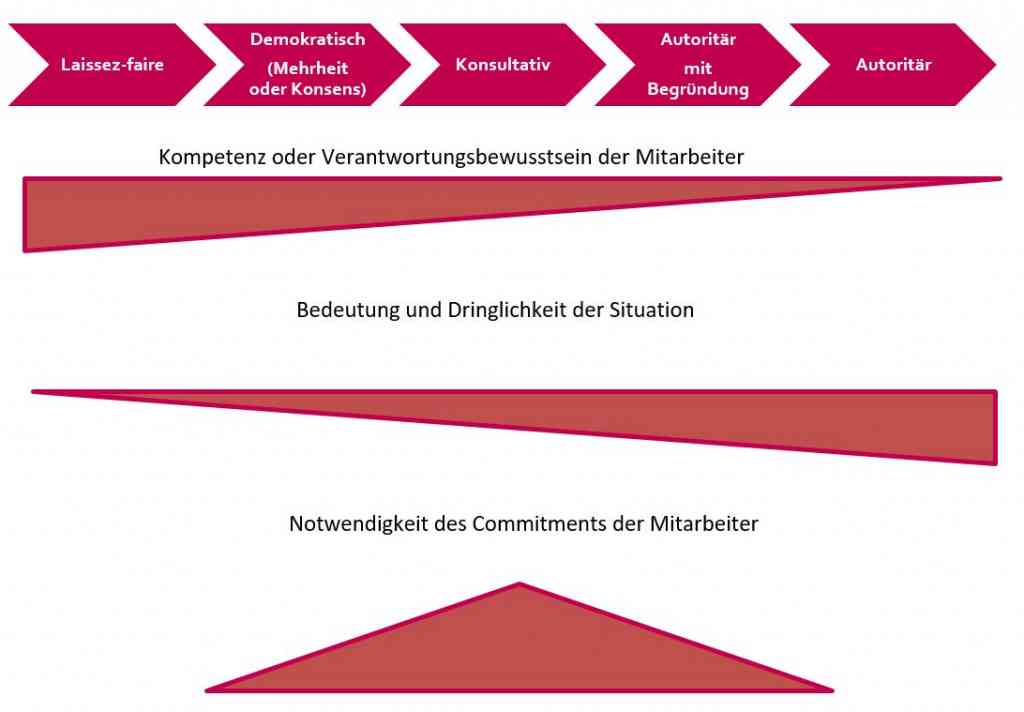
In other words, no management style is always the right one. Instead, the management style depends on the situation and the employees. A good manager should therefore be able to call on everyone. Fortunately, there are tests that check the extent to which this is the case.
Leadership strategies – The right choice
The right management style is essential. The appropriate management strategy is then selected from the resulting alternative courses of action. In principle, there are four different strategies depending on the competence and commitment of the employees:
If both components are high, you can delegate with confidence. Conversely, close monitoring of work and instructions are required. If employees are committed but do not have the necessary skills, coaching and training can help. If competence is high but commitment is low, a participative management style is a good way to get people out of their shell. Of course, there are other options in between.
Who am I dealing with?
The prerequisite for the successful implementation of style and strategy is, of course, the right approach and the right way of dealing with employees. Both are primarily determined by different personality types. Here too, there are various tests that are tried and tested and already frequently used in business, e.g. DISG or the somewhat more detailed MDI Insights. Depending on the extrovert/introvert and rational/emotional dimensions, a distinction is made between four basic types: The Analyst, the Doer, the Expressive and the Steady. There are also other names for the four types. This knowledge is important not only for self-awareness but also for important factors such as task allocation, motivation or approach. It is also important for assessing the performance of a team, because – for successful teamwork you need all types! Everyone has advantages and disadvantages and a good manager manages to combine the advantages and work successfully.
Human resource
The English term best illustrates this: human resources. The tasks of a manager therefore also include assessing which resources are available to them, such as the qualifications of employees, the atmosphere of cooperation and performance. This also includes the question: As a manager, do I have sufficient resources at my disposal? Then the manager can…
…develop strategies
To do this, the tasks must be classified and prioritized. A common classification is into important/less important and urgent/not urgent. If you only play “firefighter” (important and urgent tasks), you are doing something wrong. In fact, this classification helps to create an awareness for a productive way of working and also allows conclusions to be drawn as to whether sufficient resources are available.
Clarify expectations!
Have you ever felt the same way? A friend recommends a restaurant. You go there, there are few dishes on the menu that appeal to you and you don’t like what you order. Your expectations are disappointed. Of course you will never eat there again and if your friend recommends a restaurant to you again, you will ask him a few more questions or not go there at all. So don’t take anything for granted in the office either. Nothing is easier than following your self-image first and foremost, and nothing is more likely to disappoint expectations as a result. Even if you think you already know everything, you shouldn’t take anything for granted and at least check your assumptions. This is especially true when you take on a new role (new department, from colleague to manager, etc.), but also in day-to-day business. Nothing is more misleading than assumed clarity! This is not only about the expectations of employees, an important motivating factor, but also about the expectations of the boss. If you want to become something, you should make sure you know what expectations are placed on you from above. And last but not least: you should also clarify the expectations you have of yourself.
Did you say something? No, that was yesterday
Communication is, of course, a broad and crucial area. In addition to the personality types already mentioned, many things play a role here that you should be familiar with as a manager:
Communication on a factual and relationship level, active listening, giving feedback, critical discussions, conflicts and solution-oriented discussions. Last but not least, you should be prepared to counter unfair dialectics. Good communication is, of course, the core of leadership and requires most of the preparation for the role as a manager. But even “seasoned” managers should consciously address these issues. You can always learn and it is amazing how even small changes in behavior can have a big impact.
Motivation
Motivation means that employees complete certain tasks, but also includes their general commitment. This is not (only) about money, bonuses or promotions. It is important for managers to recognize the needs of their employees. Ultimately, however, their own attitude is crucial. What you radiate as a manager comes back to you. A boss who “doesn’t feel like it” will also get employees who “don’t feel like it”. Then what we call demotivators will dominate: Overchallenging work content (risk of burn-out!), underchallenging work content, lack of appreciation, lack of trust, bullying, lack of development / career prospects or perceived injustices (e.g. salary structure). Managers are there to eliminate these demotivators on the one hand and to provide motivators on the other, such as an interesting job, opportunities for personal development, taking on responsibility, recognition, good working conditions, creating an atmosphere of trust, ensuring clear work organization and paying attention to fair pay. Tools such as targeted communication, clarification of expectations, correct prioritization of tasks and knowledge of personality types support the manager in mastering this demanding task. The aim should always be to promote intrinsic motivation.
Delegation
Delegation is one of the core tasks of line managers. One of the prerequisites is the clarification of expectations. Employees who do not like traveling, for example, should not be sent, provided there are alternatives. In addition to clarifying who is best suited for which tasks, it is important to know and avoid the pitfalls that often prevent managers from delegating and thus becoming their own best administrators. They then take on tasks for which they actually have their people and neglect the tasks for which they are actually responsible as managers.
Appraisals and annual reviews
Last but not least, one of the tasks of a manager is to assess employees. Many companies have already established processes and procedures for this. But even if this is not the case, employees have a right to receive feedback on their performance from their superiors. As simple and obvious as this may sound, both managers and employees should prepare thoroughly for such discussions. Managers should also be aware of the effects that influence appraisals: This involves misperceptions, deceptions, distortions, different value standards, but also manipulative behavior. In order to create an appraisal that does justice to the performance of the respective employee, there are suitable methods for recognizing and eliminating or at least minimizing the distorting effects. With the communication methods described above, the performance review can then become what it should actually be: an assessment tool for past performance and a motivational tool for the future. However, this is also an opportunity for critical discussions if an employee’s performance falls short of expectations. In both cases, the manager and employee should agree on measures for the future. The comparison of self-image and external image creates transparency, which is crucial for cooperation. There is only one thing a manager must not do: shirk this task if possible because they find it uncomfortable.
Conclusion
The job of a manager is demanding and has many facets. “You’ll do it” is not a compliment, but an expression of indifference. Those who have the will and the talent should be prepared for this task or developed further if they are already a manager. Marco Reus has seized these opportunities. Through his will to succeed and the right encouragement, he has become one of the most successful footballers in the Bundesliga. But he doesn’t rest on his laurels and think to himself: “Hey, now I’m a great footballer, I don’t need to train anymore.” Permanent training ensures permanent development. All companies are therefore well advised to invest in the development of their managers. Large companies often have their own programs for this, but smaller and medium-sized companies can also open up these opportunities for their managers by offering a wide range of seminars. The battle for skilled workers is generally becoming tougher, as can be read in the press – further training opportunities are then also taking their place in the list of reasons why an employee chooses a particular company.