Chinese culture is old – very old. Confucius developed the principles according to which Chinese society functioned as early as 500 BC. And not only that. These ideas also spread to Korea and Japan.
The five relationships according to Confucius
Confucius defines five relationships, four of which are hierarchical (gray), with the upper level on the left.
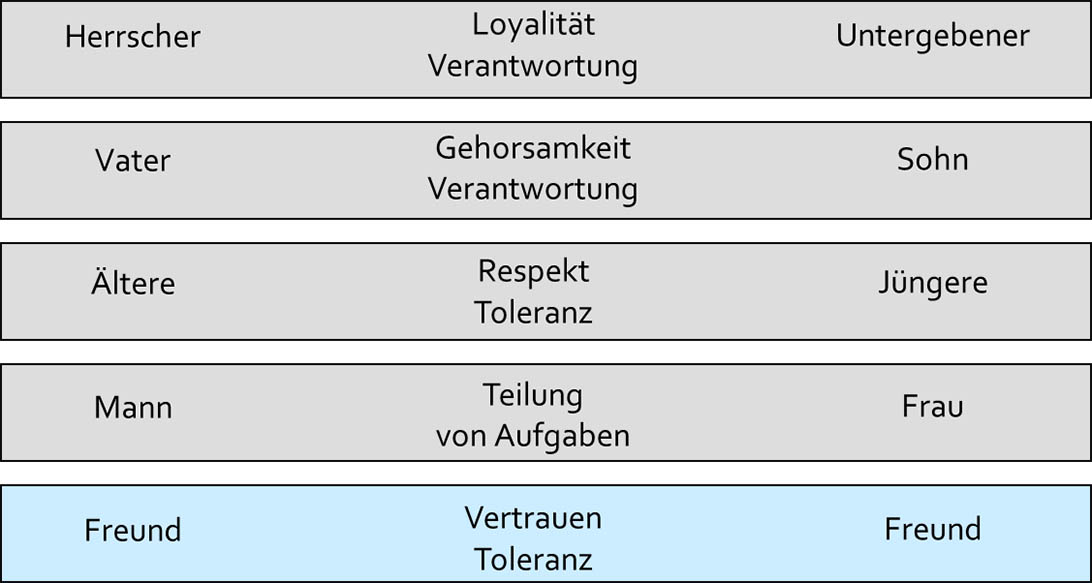
Only the relationship between friends is of equal value. The seniority principle was cemented here, as were gender roles (as was customary all over the world at the time).
Confucius also derived three social duties:
- Loyalty
- Restraint
- Preserving decency and morality
Capitalism comes late, but all the more powerful for it
For centuries, this philosophy defined Chinese society, which was strictly hierarchical and rigid in its traditions. The end of the empire came in 1912, but the values continued to exist. Civil war, World War II and communism hindered further development.
It was not until 1979 that Deng Xiaoping changed the situation. Capitalism was introduced under the guise of party and communism. Initially with the establishment of 4 special economic zones. The “Chinese economic miracle” began. Within a few decades, China went from being a developing country to an industrialized country and from being a copycat to a technology leader.
Control of population growth
At the same time, the party leadership saw unchecked population growth as a threat to the future and introduced the 1-child policy – with success. However, there is now a threat of an ageing society, which is why this policy has now been replaced by a two-child policy.
Changing values
How do Confucian values fit in with the new developments?
- Industrialization
- Capitalism
- Striving for wealth
- Small families
Spoiled only children?
Smaller families initially mean more disposable income. This encourages consumption. At the same time, however, parenting changes because all parental efforts are concentrated on one child. Is a generation of spoiled only children growing up?
New skills lead to success
Wealth and success are the result of one’s own abilities. However, increasing capitalism also favors skills such as ruthlessness, unscrupulousness and greed.
Modesty has had its day
Frugality and moderation are increasingly being replaced by consumerism and the joy of luxury. People want to treat themselves to something, now that they can, and the “temples of consumption” in the big Chinese cities are in no way inferior to those “in the West”.
A new self-confidence
Furthermore, modesty is increasingly being replaced by an open display of self-confidence and “self-marketing” based on the Western model. On the one hand, many Chinese have learned this abroad, where they completed their education. On the other hand, this gives them a competitive advantage when it comes to finding good jobs. Society is becoming more individualistic.
Traditions fade
The rapid growth is also driven by increasing mechanization. The Chinese are virtually high-tech crazy and enthusiastic about every innovation. One example: payment by phone, which has also become established at weekly markets. Convenience beats all other possible concerns, such as data security.
The appreciation of traditions and the emulation of role models is being replaced by the promotion of individual creativity. The old no longer has any meaning in the new technologized world. Traditions become sentimental customs and are devalued by the high-tech world because they no longer bring any material benefit.
Seniority put to the test
It is also possible that technological developments are gradually devaluing the principle of seniority. After all, young people now have the knowledge and qualities to survive in modern business life. This also includes intercultural and language skills to cope in the global world.
Intercultural competence China in transition
All these changes must be taken into account in intercultural training in China in order to ensure the development of adequate intercultural competence for China. This also means continuous further training for the seminar leaders, because as already mentioned, Chinese development is proceeding at a rapid pace. Of course, it is not the case that everything is thrown overboard in one fell swoop. But even a culture is not set in stone and the new development has already begun.